
Contact
AIM&DRIVECost-based challenge system
Enterprise UX
Digital Transformation
Shipped : V1.0, Q2 2018
Overview
AIM&DRIVE is a process used to optimize project costs. Developed and patented by Jimmy Anklesaria, the process is offered as a consulting service by the Anklesaria Group and is carried out by trained consultants for fortune 500 companies across the globe.
After successfully delivering value to their clients for about 10 years, the company now wanted to productise the process on a digital platform and monetize it with a subscription service, thus trying to optimize their own cost that is usually spent in having to fly out their consultants to various client locations across the globe.
The new system is supposed to consolidate all the project data that is currently managed by spreadsheets and various text and image-based documents into a digital repository for easy access, collaboration, and enabling machine learning efforts
The Team
This project was managed by a team of two. A Project manager and User Experience Designer. I was engaged in the capacity of User Experience Designer.
My Involvement
- Primary Research
- Process & Workflow Analysis
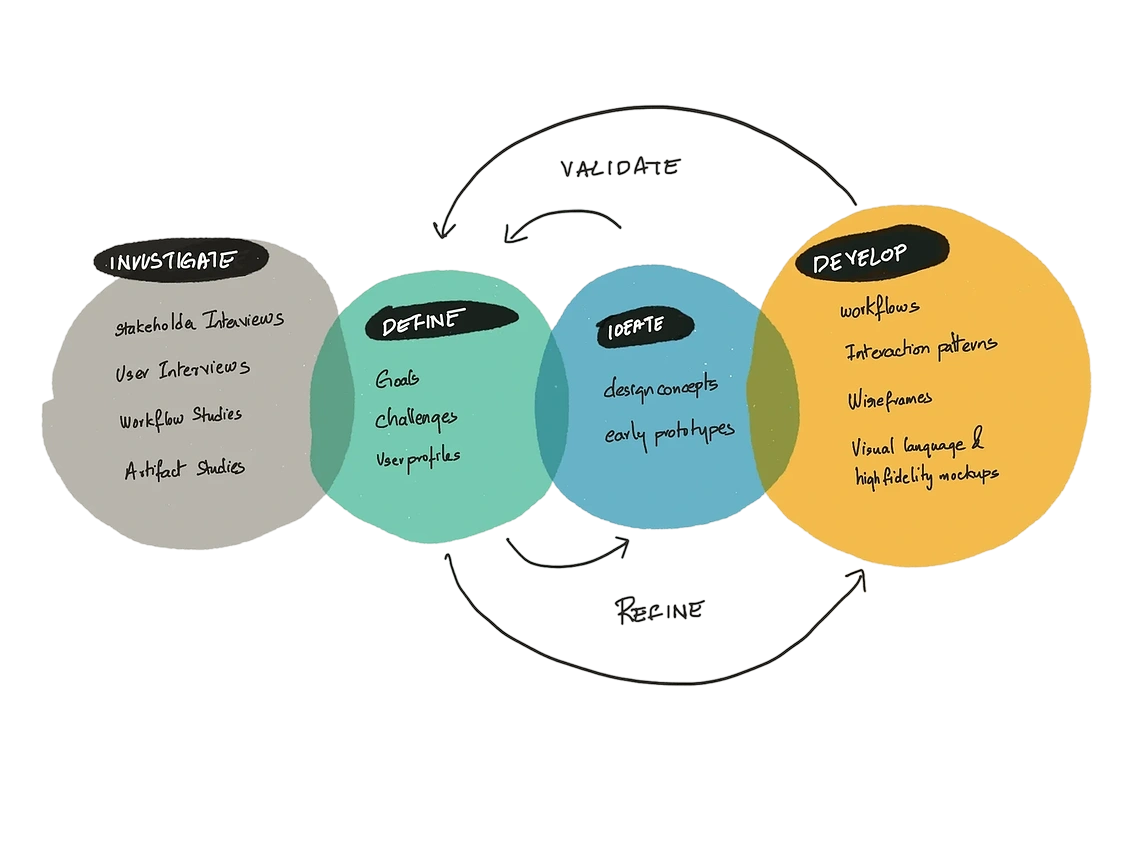
- Concept Development
- Wireframes & Prototyping
- Interaction Design
- Visual Design & Design Specifications Documentation
The Process
Workflow Study
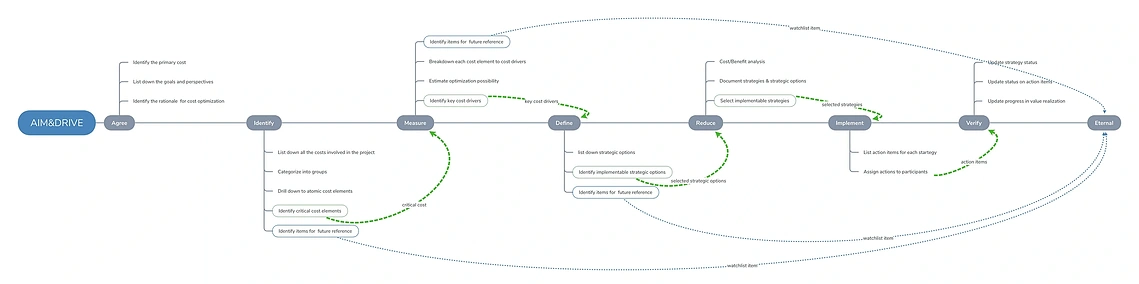
AIM&DRIVE followed a linear process of consecutive steps. The name of the process was an acronym for the steps themselves
A: Agree, I: Identity, M: Measure, D: Define, R: Reduce, I: Implement, V: Verify, E: Eternal,
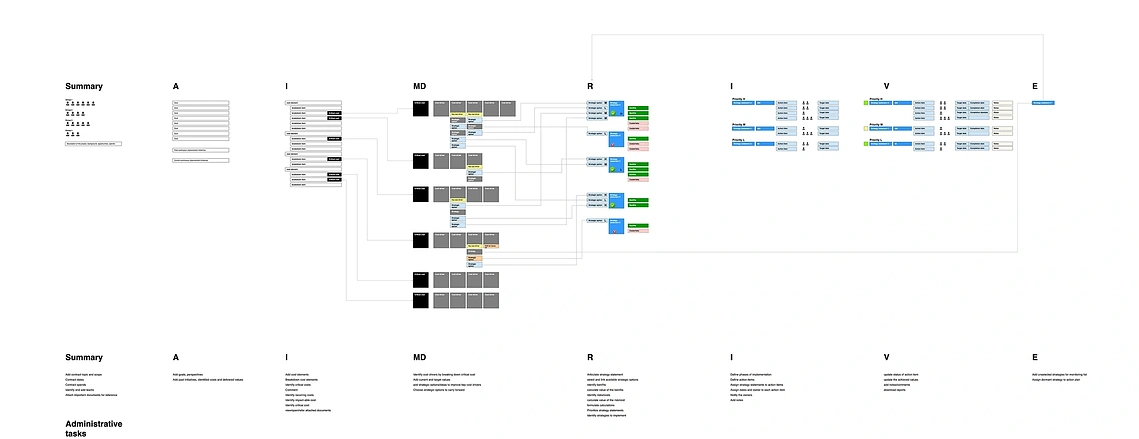
I conducted a thorough artifact study with the process documents, spreadsheets, data, and reports used by the process consultants to understand and identify opportunities for enhancing experiences beyond the digital translation of the process.
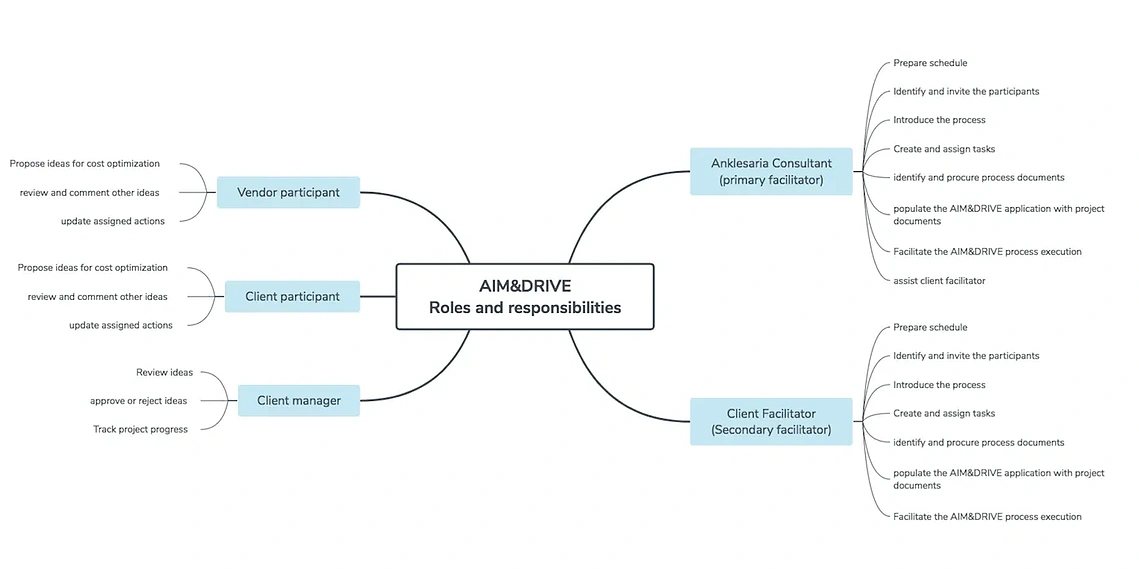
User Role Mapping
Findings
1.
The process is primarily based on the consultant’s expertise and for quite some time the company will continue to bank on it before they can depend on a representative from the client’s organization who could be trained on the AIM&DRIVE process.
4.
The process relied heavily on referring the process, engineering, and financial documents back and forth to identify potential areas to optimize cost. So it was very important to facilitate easy access to the project documents.
2.
The participant users are involved for their expertise in the domain understanding. Their input and suggestions are manually incorporated into the process by the consultant.
3.
A fair part of the AIM&DRIVE process execution cost goes on travel in the initial stages. The consultants need to travel to the customer's location and also need every participant to travel to a single location.
5.
The process is primarily an activity of identifying cost items and identifying potential strategies to optimize those cost items. The consultants heavily Microsoft Excel sheets capabilities to do the number crunching and documenting the entire process.
6.Every consultant had his own variation of the process.
7.There was no central repository of the projects.
8.
There are a few standard sets of domains within which an experienced consultant usually knows which area of cost to optimize.
9.The AIM&DRIVE workshops are sometimes carried out in locations with challenging network conditions.
Project Goals
In the order of priority
1. Build a system that can hold a central repository of all the necessary documentation and data across all the projects.
2. Integrate the new system with the most commonly used features of a spreadsheet.
3. Enable quick access to all the documents that are relevant in a certain step.
4. Enable collaborative participation with remote participants.
5. Build process and project management features such as task management and session scheduling into the system.
6. Normalize the variations in practices between different consultants.
7. The system should be able to work offline in areas of challenging network conditions.
8. Integrate AIM&DRIVE’s online learning portal to enable the consultant to refer to the process when in doubt.
9. Enable machine learning to determine common patterns across multiple projects collected in the system.
10. Enable the system to recommend areas of potential value improvements in the project.
Challenges
In the order of priority
1. The consultants used the features of cross-referencing and inbuilt formulae heavily to perform some complex financial calculations across the projects. This was one of the biggest challenges to replicate.
2. Another major challenge was to build a workflow that is true to the core process but still allowed certain variations that each consultant chooses to practice. This was a challenge primarily due to the client’s existing engineering platform.
3. Since the client was focussing on building a web platform to start with, building a system that could also work offline was not possible. This could have been solved if it was to be a mobile/tablet app. This was pushed as a Wishlist for a future release.
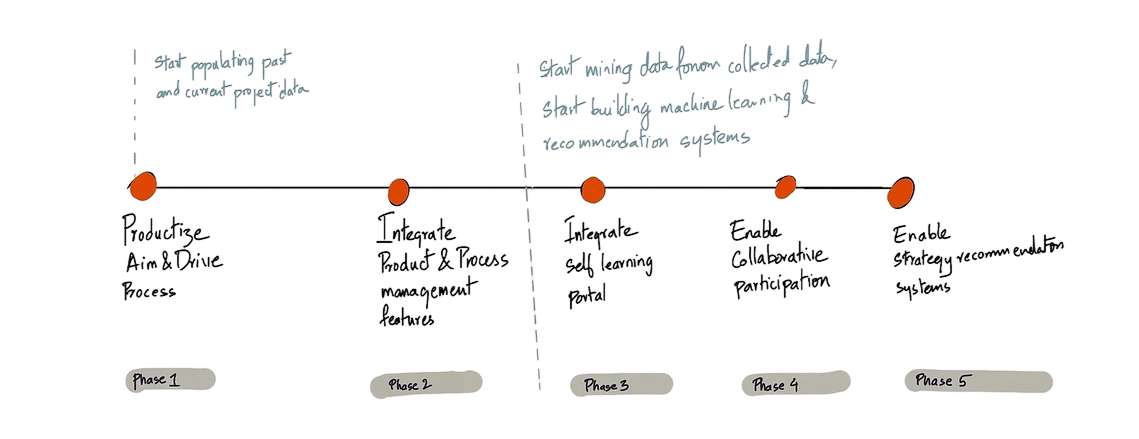
The client had an extensive wish list of goals that they wanted to achieve, but the biggest goal they had was to actually be able to deliver the first version with some key features to the customers and understand the pulse of the market.
This prevented us from focusing on all the items and we decided to split the entire wish list into various phases. the first design development focussed on phases 1 & 2 as listed below.
Initial Sketches
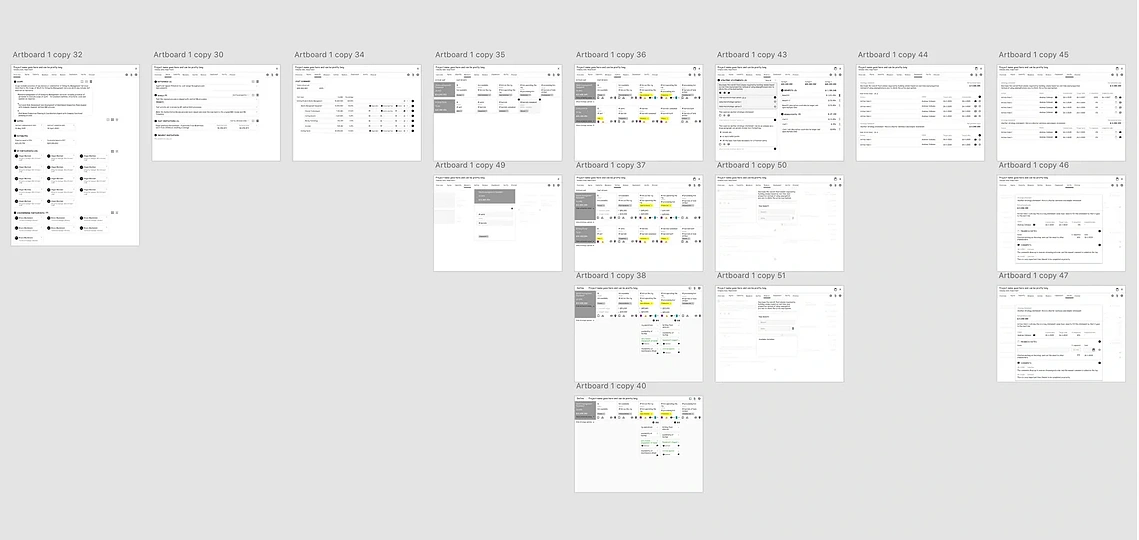
Wireframes
Final Visual Design
For the visual design, the goal was to make the system high contrast since, in Phase 1, the system was still going to be used by consultants in the presence of an entire group of participants and presented via a projector.
Project management and preparation
Click to see full image
While previously the project files were stored in unorganized files across multiple computers, the new system presented all the projects now under one portal, so the consultants could easily access all the projects to which they have authorization.
Click to see full image
The project management section allowed the consultants to seamlessly organize necessary documents, identify participants and easily schedule in-person and virtual sessions. The consultants had to use external project planning tools prior to this implementation.
Project Execution Workflow
While the main initial goal was to digitize the manual process, the final goal of the customer was to sell subscriptions to the tool and enable their client’s internal process consultants to handle the optimization process in-house. This would require considerable knowledge of the process. To ease into this process, we proposed an in-app checklist of optional training with videos and steps that the user could go through before undertaking each stem of the AIM&DRIVE process.
Click to see full image
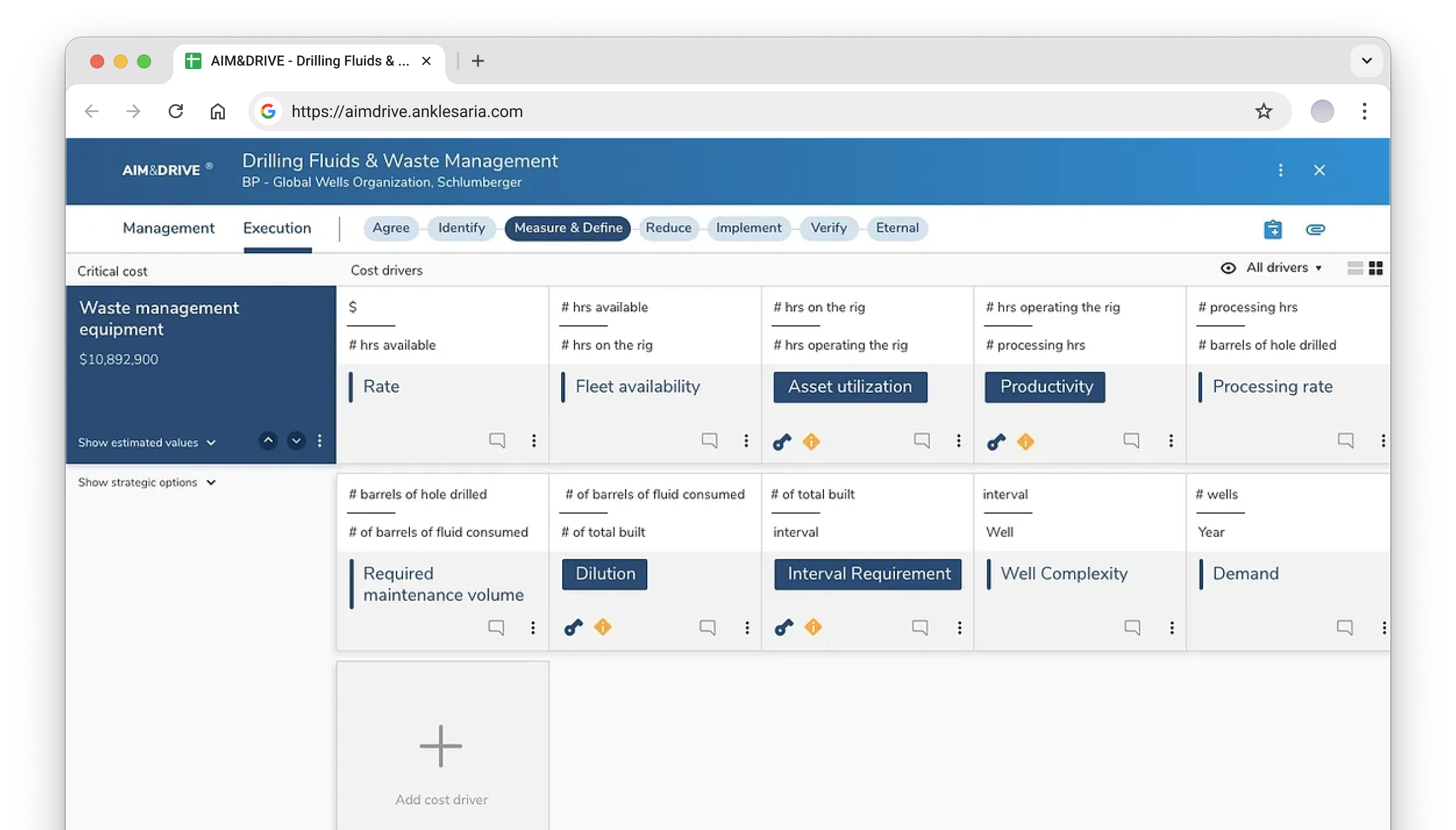
Measure & Define steps
Click to see full image
One of the major challenges during the transformation was to translate Measure & Define step where conventional spreads with a large number of columns and cells were used. While all the data was important, it was not necessary for everything to be visible at the same time. The consultants used the feature of hiding rows and columns in a spreadsheet to manage this complexity. We used a similar concept to categorize rows into Cost items and related strategic options. A feature was designed to hide the strategic options when focusing on the macro details of the projects.
Reduce, Implement, Verify
Click to see full image
Reduce, Implement, Verify
A requirement to generate reporting was identified in the later stages of developing the designs. The consultants documented post-implementation insights to the client team in a Presentation. This was another time-consuming process having to dive into large amounts of data and process documents to design the presentations.
We proposed the possibility of automating this process where the tool could generate a series of HTML blocks in the app with each block following a template from the existing reporting formats and populating data from the project inventory. This can be reviewed, updated, and then exported to a presentable PDF or Powerpoint format.
Additionally, the client team would have access to the dashboard that shows live progress into the optimization process over time from the beginning to the closure of the project.
Closing Thoughts
This was one of the few projects where I was fortunate enough to work directly and co-create with the end users. While the product had immense potential, the first phase of product development could only accommodate exploring only a few of the possible solutions because of time and technology constraints.
In a way, we were able to do a direct translation of the process from a spreadsheet-based system to an online tool and added a few capabilities of resource and project management from the same tool. It still is missing the flexibility of using a spreadsheet by power users. This could have been overcome if some of the steps like ‘Identity’ and ‘Measure & Define’ could use flexible frameworks like a digital whiteboard enabled with rich cross-referencing and advanced formulas like they are used in a spreadsheet.
Trusted By Colleagues and Clients


Elsewhere on the internet

Download CV

Contact
AIM&DRIVECost-based challenge system
Enterprise UX
Digital Transformation
Shipped : V1.0, Q2 2018
Overview
AIM&DRIVE is a process used to optimize project costs. Developed and patented by Jimmy Anklesaria, the process is offered as a consulting service by the Anklesaria Group and is carried out by trained consultants for fortune 500 companies across the globe.
After successfully delivering value to their clients for about 10 years, the company now wanted to productise the process on a digital platform and monetize it with a subscription service, thus trying to optimize their own cost that is usually spent in having to fly out their consultants to various client locations across the globe.
The new system is supposed to consolidate all the project data that is currently managed by spreadsheets and various text and image-based documents into a digital repository for easy access, collaboration, and enabling machine learning efforts
The Team
This project was managed by a team of two. A Project manager and User Experience Designer. I was engaged in the capacity of User Experience Designer.
My Involvement
- Primary Research
- Process & Workflow Analysis
- Concept Development
- Wireframes & Prototyping
- Interaction Design
- Visual Design & Design Specifications Documentation
The Process
Workflow Study
AIM&DRIVE followed a linear process of consecutive steps. The name of the process was an acronym for the steps themselves
A: Agree, I: Identity, M: Measure, D: Define, R: Reduce, I: Implement, V: Verify, E: Eternal,
I conducted a thorough artifact study with the process documents, spreadsheets, data, and reports used by the process consultants to understand and identify opportunities for enhancing experiences beyond the digital translation of the process.
User Role Mapping
Findings
1.
The process is primarily based on the consultant’s expertise and for quite some time the company will continue to bank on it before they can depend on a representative from the client’s organization who could be trained on the AIM&DRIVE process.
4.
The process relied heavily on referring the process, engineering, and financial documents back and forth to identify potential areas to optimize cost. So it was very important to facilitate easy access to the project documents.
2.
The participant users are involved for their expertise in the domain understanding. Their input and suggestions are manually incorporated into the process by the consultant.
3.
A fair part of the AIM&DRIVE process execution cost goes on travel in the initial stages. The consultants need to travel to the customer's location and also need every participant to travel to a single location.
5.
The process is primarily an activity of identifying cost items and identifying potential strategies to optimize those cost items. The consultants heavily Microsoft Excel sheets capabilities to do the number crunching and documenting the entire process.
6.Every consultant had his own variation of the process.
7.There was no central repository of the projects.
8.
There are a few standard sets of domains within which an experienced consultant usually knows which area of cost to optimize.
9.The AIM&DRIVE workshops are sometimes carried out in locations with challenging network conditions.
Project Goals
In the order of priority
1. Build a system that can hold a central repository of all the necessary documentation and data across all the projects.
2. Integrate the new system with the most commonly used features of a spreadsheet.
3. Enable quick access to all the documents that are relevant in a certain step.
4. Enable collaborative participation with remote participants.
5. Build process and project management features such as task management and session scheduling into the system.
6. Normalize the variations in practices between different consultants.
7. The system should be able to work offline in areas of challenging network conditions.
8. Integrate AIM&DRIVE’s online learning portal to enable the consultant to refer to the process when in doubt.
9. Enable machine learning to determine common patterns across multiple projects collected in the system.
10. Enable the system to recommend areas of potential value improvements in the project.
Challenges
In the order of priority
1. The consultants used the features of cross-referencing and inbuilt formulae heavily to perform some complex financial calculations across the projects. This was one of the biggest challenges to replicate.
2. Another major challenge was to build a workflow that is true to the core process but still allowed certain variations that each consultant chooses to practice. This was a challenge primarily due to the client’s existing engineering platform.
3. Since the client was focussing on building a web platform to start with, building a system that could also work offline was not possible. This could have been solved if it was to be a mobile/tablet app. This was pushed as a Wishlist for a future release.
The client had an extensive wish list of goals that they wanted to achieve, but the biggest goal they had was to actually be able to deliver the first version with some key features to the customers and understand the pulse of the market.
This prevented us from focusing on all the items and we decided to split the entire wish list into various phases. the first design development focussed on phases 1 & 2 as listed below.
Initial Sketches
Wireframes
Final Visual Design
For the visual design, the goal was to make the system high contrast since, in Phase 1, the system was still going to be used by consultants in the presence of an entire group of participants and presented via a projector.
Project management and preparation
Click to see full image
While previously the project files were stored in unorganized files across multiple computers, the new system presented all the projects now under one portal, so the consultants could easily access all the projects to which they have authorization.
Click to see full image
The project management section allowed the consultants to seamlessly organize necessary documents, identify participants and easily schedule in-person and virtual sessions. The consultants had to use external project planning tools prior to this implementation.
Project Execution Workflow
While the main initial goal was to digitize the manual process, the final goal of the customer was to sell subscriptions to the tool and enable their client’s internal process consultants to handle the optimization process in-house. This would require considerable knowledge of the process. To ease into this process, we proposed an in-app checklist of optional training with videos and steps that the user could go through before undertaking each stem of the AIM&DRIVE process.
Click to see full image
Measure & Define steps
Click to see full image
One of the major challenges during the transformation was to translate Measure & Define step where conventional spreads with a large number of columns and cells were used. While all the data was important, it was not necessary for everything to be visible at the same time. The consultants used the feature of hiding rows and columns in a spreadsheet to manage this complexity. We used a similar concept to categorize rows into Cost items and related strategic options. A feature was designed to hide the strategic options when focusing on the macro details of the projects.
Reduce, Implement, Verify
Click to see full image
Reduce, Implement, Verify
A requirement to generate reporting was identified in the later stages of developing the designs. The consultants documented post-implementation insights to the client team in a Presentation. This was another time-consuming process having to dive into large amounts of data and process documents to design the presentations.
We proposed the possibility of automating this process where the tool could generate a series of HTML blocks in the app with each block following a template from the existing reporting formats and populating data from the project inventory. This can be reviewed, updated, and then exported to a presentable PDF or Powerpoint format.
Additionally, the client team would have access to the dashboard that shows live progress into the optimization process over time from the beginning to the closure of the project.
Closing Thoughts
This was one of the few projects where I was fortunate enough to work directly and co-create with the end users. While the product had immense potential, the first phase of product development could only accommodate exploring only a few of the possible solutions because of time and technology constraints.
In a way, we were able to do a direct translation of the process from a spreadsheet-based system to an online tool and added a few capabilities of resource and project management from the same tool. It still is missing the flexibility of using a spreadsheet by power users. This could have been overcome if some of the steps like ‘Identity’ and ‘Measure & Define’ could use flexible frameworks like a digital whiteboard enabled with rich cross-referencing and advanced formulas like they are used in a spreadsheet.
Trusted By Colleagues and Clients
Elsewhere on the internet
Download CV
Contact
AIM&DRIVECost-based challenge system
Enterprise UX
Digital Transformation
Shipped : V1.0, Q2 2018
Overview
AIM&DRIVE is a process used to optimize project costs. Developed and patented by Jimmy Anklesaria, the process is offered as a consulting service by the Anklesaria Group and is carried out by trained consultants for fortune 500 companies across the globe.
After successfully delivering value to their clients for about 10 years, the company now wanted to productise the process on a digital platform and monetize it with a subscription service, thus trying to optimize their own cost that is usually spent in having to fly out their consultants to various client locations across the globe.
The new system is supposed to consolidate all the project data that is currently managed by spreadsheets and various text and image-based documents into a digital repository for easy access, collaboration, and enabling machine learning efforts
The Team
This project was managed by a team of two. A Project manager and User Experience Designer. I was engaged in the capacity of User Experience Designer.
My Involvement
- Primary Research
- Process & Workflow Analysis
- Concept Development
- Wireframes & Prototyping
- Interaction Design
- Visual Design & Design Specifications Documentation
The Process
Workflow Study
AIM&DRIVE followed a linear process of consecutive steps. The name of the process was an acronym for the steps themselves
A: Agree, I: Identity, M: Measure, D: Define, R: Reduce, I: Implement, V: Verify, E: Eternal,
I conducted a thorough artifact study with the process documents, spreadsheets, data, and reports used by the process consultants to understand and identify opportunities for enhancing experiences beyond the digital translation of the process.
User Role Mapping
Findings
1.
The process is primarily based on the consultant’s expertise and for quite some time the company will continue to bank on it before they can depend on a representative from the client’s organization who could be trained on the AIM&DRIVE process.
4.
The process relied heavily on referring the process, engineering, and financial documents back and forth to identify potential areas to optimize cost. So it was very important to facilitate easy access to the project documents.
2.
The participant users are involved for their expertise in the domain understanding. Their input and suggestions are manually incorporated into the process by the consultant.
3.
A fair part of the AIM&DRIVE process execution cost goes on travel in the initial stages. The consultants need to travel to the customer's location and also need every participant to travel to a single location.
5.
The process is primarily an activity of identifying cost items and identifying potential strategies to optimize those cost items. The consultants heavily Microsoft Excel sheets capabilities to do the number crunching and documenting the entire process.
6.Every consultant had his own variation of the process.
7.There was no central repository of the projects.
8.
There are a few standard sets of domains within which an experienced consultant usually knows which area of cost to optimize.
9.The AIM&DRIVE workshops are sometimes carried out in locations with challenging network conditions.
Project Goals
In the order of priority
1. Build a system that can hold a central repository of all the necessary documentation and data across all the projects.
2. Integrate the new system with the most commonly used features of a spreadsheet.
3. Enable quick access to all the documents that are relevant in a certain step.
4. Enable collaborative participation with remote participants.
5. Build process and project management features such as task management and session scheduling into the system.
6. Normalize the variations in practices between different consultants.
7. The system should be able to work offline in areas of challenging network conditions.
8. Integrate AIM&DRIVE’s online learning portal to enable the consultant to refer to the process when in doubt.
9. Enable machine learning to determine common patterns across multiple projects collected in the system.
10. Enable the system to recommend areas of potential value improvements in the project.
Challenges
In the order of priority
1. The consultants used the features of cross-referencing and inbuilt formulae heavily to perform some complex financial calculations across the projects. This was one of the biggest challenges to replicate.
2. Another major challenge was to build a workflow that is true to the core process but still allowed certain variations that each consultant chooses to practice. This was a challenge primarily due to the client’s existing engineering platform.
3. Since the client was focussing on building a web platform to start with, building a system that could also work offline was not possible. This could have been solved if it was to be a mobile/tablet app. This was pushed as a Wishlist for a future release.
The client had an extensive wish list of goals that they wanted to achieve, but the biggest goal they had was to actually be able to deliver the first version with some key features to the customers and understand the pulse of the market.
This prevented us from focusing on all the items and we decided to split the entire wish list into various phases. the first design development focussed on phases 1 & 2 as listed below.
Initial Sketches
Wireframes
Final Visual Design
For the visual design, the goal was to make the system high contrast since, in Phase 1, the system was still going to be used by consultants in the presence of an entire group of participants and presented via a projector.
Project management and preparation
Click to see full image
While previously the project files were stored in unorganized files across multiple computers, the new system presented all the projects now under one portal, so the consultants could easily access all the projects to which they have authorization.
Click to see full image
The project management section allowed the consultants to seamlessly organize necessary documents, identify participants and easily schedule in-person and virtual sessions. The consultants had to use external project planning tools prior to this implementation.
Project Execution Workflow
While the main initial goal was to digitize the manual process, the final goal of the customer was to sell subscriptions to the tool and enable their client’s internal process consultants to handle the optimization process in-house. This would require considerable knowledge of the process. To ease into this process, we proposed an in-app checklist of optional training with videos and steps that the user could go through before undertaking each stem of the AIM&DRIVE process.
Click to see full image
Measure & Define steps
Click to see full image
One of the major challenges during the transformation was to translate Measure & Define step where conventional spreads with a large number of columns and cells were used. While all the data was important, it was not necessary for everything to be visible at the same time. The consultants used the feature of hiding rows and columns in a spreadsheet to manage this complexity. We used a similar concept to categorize rows into Cost items and related strategic options. A feature was designed to hide the strategic options when focusing on the macro details of the projects.
Reduce, Implement, Verify
Click to see full image
Reduce, Implement, Verify
A requirement to generate reporting was identified in the later stages of developing the designs. The consultants documented post-implementation insights to the client team in a Presentation. This was another time-consuming process having to dive into large amounts of data and process documents to design the presentations.
We proposed the possibility of automating this process where the tool could generate a series of HTML blocks in the app with each block following a template from the existing reporting formats and populating data from the project inventory. This can be reviewed, updated, and then exported to a presentable PDF or Powerpoint format.
Additionally, the client team would have access to the dashboard that shows live progress into the optimization process over time from the beginning to the closure of the project.
Closing Thoughts
This was one of the few projects where I was fortunate enough to work directly and co-create with the end users. While the product had immense potential, the first phase of product development could only accommodate exploring only a few of the possible solutions because of time and technology constraints.
In a way, we were able to do a direct translation of the process from a spreadsheet-based system to an online tool and added a few capabilities of resource and project management from the same tool. It still is missing the flexibility of using a spreadsheet by power users. This could have been overcome if some of the steps like ‘Identity’ and ‘Measure & Define’ could use flexible frameworks like a digital whiteboard enabled with rich cross-referencing and advanced formulas like they are used in a spreadsheet.
Trusted By Colleagues and Clients
Elsewhere on the internet